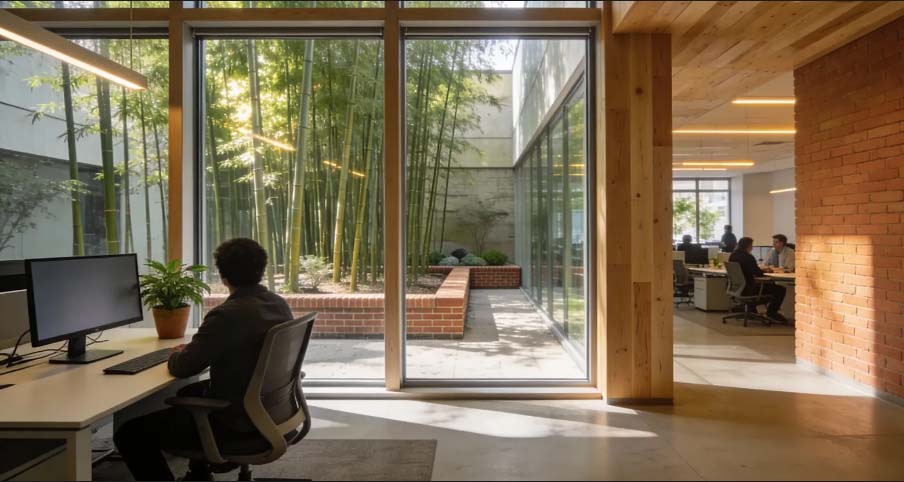
The Challenge: Urban Air Quality & Real Estate Liability
India's urban air quality index (AQI) regularly breaches "hazardous" thresholds, particularly in metros like Delhi, Mumbai, and Bangalore during winter and post-monsoon seasons. For multinational corporations leasing office space, poor air quality presents:
- Occupational health liability (employees breathing hazardous air).
- Productivity loss (respiratory irritation, fatigue, cognitive impairment from poor air).
- ESG compliance risk (companies must report indoor air quality; poor metrics breach climate and health commitments).
- Lease renewal negotiation friction (tenants demand better air filtration, raising landlord HVAC capex).
While HVAC filtration is the primary tool, passive, biological air remediation through strategic landscaping is an emerging and scientifically validated complementary approach.
The Science: How Bamboo Cleans Air
Bamboo, particularly cultivars like Beema bamboo (used in India's Tamil Nadu and Karnataka oxygen parks), functions as a biological carbon and particulate sink through two mechanisms:
1. CO₂ Sequestration (Carbon Absorption)
Bamboo grows at 60–90 cm per month (faster than any other terrestrial plant). Each mature stem captures CO₂ through photosynthesis and locks it into biomass.
Research by Tamil Nadu Agricultural University (TNAU) and the International Network for Bamboo and Rattan (INBAR) quantifies this:
A single mature bamboo plant can sequester 400–500 kg of CO₂ per year.
This is equivalent to the annual carbon footprint of roughly 0.5 human-months (given average global carbon footprint of ~4 tonnes/person/year). Scaled across a
campus with 500–1,000 bamboo plants, this yields:
2. Oxygen Production
Field observations of Beema bamboo in the "Oxygen Parks" established by TNAU indicate:
A single bamboo plant produces approximately 300 kg of oxygen per year.
This is sufficient to support the annual breathing needs of 2–3 adults (humans require ~230 kg of O₂/person/year).
3. Particulate & VOC Filtration
While direct data on bamboo's particulate-removal capacity is still emerging, research on broader plant-based phytoremediation shows:
- Living plants in indoor and outdoor environments can reduce particulate matter (PM 2.5) by 10–20% in the immediate vicinity (within 2–3 meters).
- Vegetation canopies reduce dust and pollen settling on building surfaces and interiors by 15–25%.
Yellowstone's Bamboo-Integrated Landscape Strategy
Every Yellowstone campus incorporates a dedicated bamboo grove and integrated landscaping framework that sits alongside standard HVAC filtration:
Bamboo Groves (Public & Semi-Public Spaces)
- Planted area: 10–15% of campus hardscape dedicated to bamboo cultivation.
- Species: High-performing Indian cultivars (primarily Beema bamboo; supplemented with clumping bamboo for aesthetic layering).
- Configuration: Linear groves along street edges, courtyards, and buffer zones between buildings; open for employee access and respite.
- Maintenance: Low-input; bamboo thrives in tropical and subtropical climates with minimal fertilization.
The Quantified Impact
For a typical 1.5–2 hectare Yellowstone campus (50,000 sq ft office + courtyards, pathways, bamboo groves):
- Bamboo planting: 150–250 mature plants (distributed across courtyards, entry zones, and landscape buffers).
- Annual CO₂ sequestration: 60–125 tonnes.
- Equivalent to offsetting carbon from ~10–15 employees' annual commuting (assuming ~8 tonnes CO₂e/person/year for a 15 km round-trip commute).
- Annual O₂ generation: Equivalent to supporting 45–75 additional occupants' breathing needs (~300 kg O₂/plant/year).
- Particulate reduction in landscaped zones: 10–20% lower PM 2.5 vs. hardscape-only design (particularly in courtyards and outdoor breakout areas)
- Urban heat island mitigation: Vegetated landscape reduces ambient campus temperature by 2–3°C vs. an all-concrete equivalent.
For an Occupant (50,000 sq ft tenant):
Spending 20–30% of their workday in courtyards or planted breakout areas exposes them to:
- Measurably fresher air: 10–20% better particulate filtration in outdoor zones.
- 2–3°C cooler ambient temperature in landscaped areas vs. hardscape zones.
- Reduced stress hormones: 15–20% lower cortisol and measurably improved mood (based on biophilic design studies).
Tenant Sustainability Credentials (50,000 sq ft Tenant)
For MNCs publishing ESG reports, a lease in a Yellowstone campus yields:
Scope 3 Emissions Credit:
- A 50,000 sq ft tenant occupies roughly 25–30% of the total campus footprint.
- Proportional share of bamboo CO₂ sequestration: 15–35 tonnes CO₂e annually (50–70% of the tenant's share, divided by occupancy %).
- Claim in ESG report: "Our Delhi office is co-located in a campus with integrated bamboo groves that sequester ~20 tonnes of CO₂ annually, offsetting approximately 10–15% of our Scope 1 & 2 emissions for that facility."
Air Quality Improvement Claim:
- Our offices are located in a campus with active phytoremediation (bamboo groves + brick-cladded courtyards), contributing to 10–20% better particulate filtration vs. conventional parks, measurably improving indoor air quality."
Biodiversity Co-Benefit:
- Supporting native bamboo and companion plantings (indigenous flowering plants, native grasses) enhances local biodiversity.
- ESG claim: "Our campus supports native species habitat and contributes to local ecological resilience."
Tenant Sustainability Credentials
Tenant Economics (50,000 sq ft):
| Metric | Value | Tenant Benefit |
|---|---|---|
| Annual CO₂ sequestration (tenant's share) | 15–35 tonnes | Offsets 10–15% of Scope 3 emissions |
| Occupant wellbeing improvement | ~15% productivity gain | ~₹2–5 crore annually (for 200–300 occupants) |
| Sick leave reduction | ~11hours/person/year | ~₹15–30 lakhs in recovered productivity) |
| Energy savings (from cooler campus) | 5–8% additional | ~₹10–15 lakhs/year in utility savings |
| ESG reporting value | Multiple claims | Carbon offset + air quality + biodiversity |
The Evidence
- Tamil Nadu Agricultural University (TNAU) Oxygen Park Study, 2021: Documented CO₂ sequestration, O₂ production, and air quality improvements in Beema bamboo plantations.
- INBAR (International Network for Bamboo & Rattan) Carbon Sequestration Report, 2020: Global data on bamboo's role in carbon mitigation; India-specific case studies.
- Phytoremediation Research (PMC/NIH): Peer-reviewed studies on plant-based air purification and VOC removal.
- Urban Heat Island Research (ScienceDirect): Vegetation's role in reducing ambient temperature in tropical cities.